The Type 30: the screen that made Spacewar! possible
One dot at a time
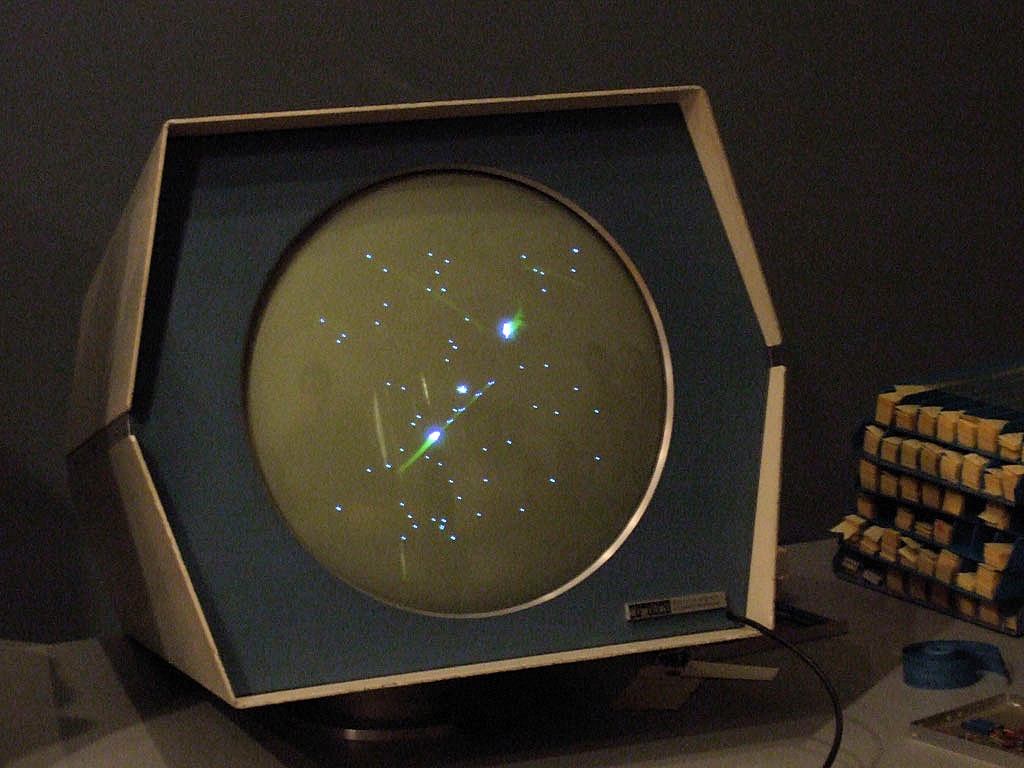
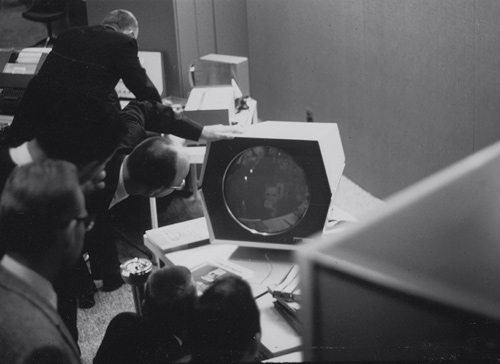
The Type 30 was a 16-inch cathode ray tube in an adjustable mounting, with its control unit and power supplies built into a table beneath it. DEC's handbook describes it as "solid state, self-powered and completely buffered," with magnetic focus and deflection. The program handed it an X and a Y coordinate, each a signed ten-bit number, and on the dpy instruction the hardware lit a single spot at that position. There was no line drawing and no stored picture: just discrete points, plotted in any order.
| Display type | Random point-plotting CRT (optional on the PDP-1) |
|---|---|
| Tube | 16-inch CRT, fixed origin at the centre of the screen |
| Raster (plotting area) | 9.25 by 9.25 inches |
| Addressable points | 1024 by 1024 (10-bit X, 10-bit Y), of which about 512 along each axis are individually discernible on the tube |
| Plotting rate | 20,000 points per second (one point every 50 microseconds) |
| Accuracy | ±3 per cent of raster size |
| Arithmetic | Ones complement (matching the PDP-1) |
| Instruction | dpy (octal 0007): AC bits 0–9 give the signed X coordinate, IO bits 0–9 the signed Y; the instruction also clears the light-pen status bit |
| Options | Type 32 light pen; the Type 33 symbol generator for fast text |
The tube is 16 inches (its diameter); the actual plotting area is 9.25 inches square. And the grid is 1024 by 1024 addressable locations, but the eye can only resolve about 512 distinct points per axis on the phosphor, so "512" is a limit of what you can see, not a smaller image drawn inside a larger frame.
Why the Type 30 is round, in that strangely shaped housing
The Type 30's circular face and bulky cabinet are not a styling choice; they follow from what the device is. It is, in essence, a large laboratory oscilloscope and radar tube driven point by point, not a television. Its whole lineage, the X/Y deflection display and the long-persistence P7 phosphor borrowed from radar, came in round tubes, and DEC's display inherited the form along with the function. Round was simply the standard shape for a scientific CRT at the end of the 1950s; rectangular faces were a later development of consumer television.
There is also a physical reason the early tubes stayed round. A CRT is an evacuated glass envelope, so the atmosphere presses inward on it with roughly fifteen pounds per square inch, which over a 16-inch face is more than a tonne of force. A circular face spreads that implosion stress evenly; the corners of a square or rectangular face concentrate it and invite a crack. Television manufacturers only went rectangular once they could make reinforced, banded, implosion-protected glass.
The deep housing, in turn, holds the hardware that drives the beam. The Type 30 used magnetic focus and deflection, so it needed a deflection yoke around the tube neck together with the deflection amplifiers, the high-voltage supply and the control electronics, all of which DEC built into the cabinet and the table beneath, leaving only the round face showing through its bezel. One consequence reaches straight into the code: because the beam is deflected from the centre of a round face, the natural coordinate system is centre-origin and signed, exactly the ten-bit signed space the program plots into, with Spacewar! drawing its action into a 9.25-inch square region inset within the 16-inch circle.
A note on sourcing: the magnetic focus and deflection, the self-powered cabinet and the centre origin are from DEC's PDP-1 Handbook; the vacuum-implosion rationale for round glass is the standard engineering explanation for early CRT shape rather than a claim made in the handbook itself.
The Type 30 among its relatives
The Type 30 was one of a small family of DEC displays and display options in this period. The most important distinction in the table is the last technical one: every display here except the Type 340 plots only individual points; the 340 could draw lines and curves in hardware. (The Type 32 is not a display at all but the light pen; the Type 33 is a hardware character generator that drove the Type 30.)
| Type | Name | Host(s) | Technology | Resolution | Speed | Light pen | Year |
|---|---|---|---|---|---|---|---|
| 30 | Precision CRT Display | PDP-1 | Point-plot only | 1024×1024 addressable (~512/axis visible); 9.25″ raster, 16″ tube | 20,000 pts/sec | Type 32 | ~1961 |
| 31 | Ultra-Precision CRT | PDP-1 | Point-plot | 4096×4096 addressable; 3″ raster, 5″ tube | for photographic recording | – | ~1963 |
| 32 | Light Pen | PDP-1 (Type 30/31) | Input device | – | – | is the pen | ~1962 |
| 33 | Digital Symbol Generator | PDP-1 (with Type 30) | Hardware character generator, 5×7 matrix, 4 sizes | – | ~10× the Type 30 character rate | – | 1964 |
| 340 | Precision Incremental CRT | PDP-1/4/6/7 | Points, vectors, curves, characters | 1024×1024; 8 intensity levels | 1.5 µs/point (vector); 35 µs random point | Type 370 | ~1964 |
The Type 30 itself came in minor variants that were "identical in operation and circuitry": the 30A without external-oscilloscope outputs, the 30E with five BNC connectors to drive an external monitoring scope, and the 30M with a switch to swap the horizontal and vertical axes. Character generation on the Type 340 used a separate Type 342 symbol generator. Figures from the DEC PDP-1 Handbook (F-15D, 1963), the Type 30E manual (F-15(30E), 1963) and the Type 340 manuals (1964).
Why the Type 30 forced a redraw loop
The single most consequential fact about the Type 30 is that it plotted only points. To show a ship, the program had to compute and plot each of its points; to keep the ship visible, it had to do so again on the next pass, and the next, forever. There is no other way to put a stable image on the screen. This is why Spacewar!, and every game descended from it on this hardware, is built as a tight redraw loop: the form of the program is dictated by the display.
DEC's later Type 340 shows what a difference hardware makes. Designed for the PDP-1, PDP-4, PDP-6 and PDP-7, it could draw not just points but straight lines, curves and characters directly, with eight levels of brightness, taking a stream of commands from a display list in memory. A line that the Type 30 had to build point by point, the 340 drew in a single operation. This is the display behind the Cambridge PDP-7 Duel, and the reason the arcade descendants of the game settled onto vector hardware: the Type 340 was a generation beyond the point-plotting Type 30, even though both addressed the same 1024 by 1024 grid.
Why Spacewar! glows and trails
That long afterglow is doing two jobs in Spacewar!. It lets a point-plotting display, which can only ever show one dot at a time, read as a stable picture even at a modest refresh rate, because each point keeps glowing while the program goes off to plot the others. And it is what gives moving objects their fading trails: a torpedo or a ship leaves a green wake behind its bright blue head, and the jittered central star smears into a glowing sun. The motion blur so characteristic of the game is not a software effect; it is the chemistry of the screen.
A note on sourcing: DEC's PDP-1 handbook does not itself name the phosphor. "P7" comes from the tube's part number (16ADP7, the "P7" being the phosphor designation) and from standard phosphor references.
Writing on the face of the tube
The display had an input as well as an output. The Type 32 light pen was a photosensitive stylus that fired when the beam plotted a point beneath its tip. As DEC's handbook puts it, "by writing on the face of the CRT, stored or displayed information can be expanded, deleted or modified." When the pen saw a point, the hardware set a status bit and Program Flag 3, and left the X and Y coordinates of that point in the AC and IO registers, so a program could tell which displayed point had been pointed at. It is the same lineage of pen-based interaction the MIT hackers knew from the TX-0, and an early instance of pointing at a screen to edit what is on it, a decade and more before the mouse.
The display is in the code
For a Critical Code Studies reading, the Type 30 is a crucial part of the media materiality of the system. Its point-plotting design makes the game a redraw loop. Its ten-bit, centre-origin coordinate system is the space the physics is computed in. Its P7 phosphor supplies the trails, and this led to the smeared sun look, an accident of the hardware limitations. Examining the display closely, you find its materiality affects every part of the Spacewar! game.
References
- DEC, PDP-1 Handbook (F-15D, 1963), for the Type 30, Type 31, Type 32 light pen and Type 33 symbol generator (read directly from the bitsavers scan).
- DEC, Type 30E Precision CRT Display manual (F-15(30E), 1963), for the 30A / 30E / 30M variants and the external-oscilloscope outputs.
- DEC, Type 340 Precision Incremental CRT Display manuals (1964), for the vector display, its modes, the Type 342 symbol generator and the Type 370 light pen.
- On P7: standard CRT phosphor references and the tube designation 16ADP7. See also Norbert Landsteiner, Inside Spacewar!, on the display and its trails.
- Computer History Museum, PDP-1 Restoration Project, for the 29 December 1961 installation date and the restored display.